Rethinking Virtualization Strategies

For many years, VMware was considered the de facto standard in enterprise virtualization. The platform enabled efficient consolidation of server landscapes and formed the foundation of numerous data centers.
However, since its acquisition by Broadcom, significant framework conditions have changed. New licensing models, rising costs, and adjustments to the product strategy are prompting many companies to re-evaluate their existing infrastructure.
A survey published in April 2026 by the analyst firm Virtified shows that around half of the surveyed VMware users plan to reduce their use of the platform by 2028. The international study involved 450 IT professionals from companies with more than 500 employees in 14 countries.
The discussion thus extends far beyond technical questions. For IT managers, it is increasingly about how much control they retain over their infrastructure in the long term and what dependencies they are willing to enter into.
A VMware exit is not an end in itself. The decisive factor is whether the existing virtualization strategy continues to meet economic, technical, and organizational requirements.
The changes surrounding VMware highlight a fundamental risk of proprietary IT infrastructures: those who align central systems with a single vendor become dependent on that vendor’s decisions.
This dependence, also known as vendor lock-in, affects more than just license costs. Product strategies, pricing, support conditions, and innovation cycles can change without users having direct influence.
This becomes a problem, especially for long-term infrastructure projects. Data centers and virtualization environments are often planned for periods of five to ten years. Companies therefore need reliable framework conditions to be able to calculate investments and operating costs.
The central question is therefore not solely whether VMware will become more expensive in the future. Rather, companies should examine how strongly their infrastructure depends on a single provider and what options they have to expand their technological freedom of action.
“The search for a VMware alternative is not just about license costs. It is crucial that companies retain long-term control over their IT infrastructure and can determine their technological development themselves.”
Jerome Evans, Founder and Managing Director of firstcolo
Which VMware alternative is suitable depends on the requirements for virtualization, scalability, and operation. Open-source-based options include OpenStack and Proxmox VE.
OpenStack, in particular, is developing into a strategic alternative for managed service providers and enterprise customers. The platform is based on open standards and interfaces. It is developed independently of a single vendor and enables companies to align their infrastructure architecture more closely with their own requirements.
This allows decisions about extensions, automation, and migrations to be made more flexibly. Companies can plan their technological roadmap more independently and reduce dependence on proprietary ecosystems.
Proxmox VE is also an open-source-based alternative in the virtualization environment. However, the areas of application differ: While Proxmox VE primarily addresses the management of virtualized server environments, OpenStack is designed as a comprehensive cloud infrastructure platform.
Which solution is suitable depends on the existing IT landscape, the required functions, and the planned operating model.
A detailed comparison of VMware and Proxmox shows the differences between proprietary and open virtualization solutions.
When evaluating a VMware alternative, license fees are often the focus. However, this comparison is not sufficient for a well-founded decision.
The Total Cost of Ownership (TCO) is crucial. In addition to software licenses, this includes expenses for operation, automation, support, scaling, and qualified personnel.
Open-source platforms pursue a different approach here. Instead of proprietary license fees, operational expertise, architectural know-how, and infrastructure design come to the fore.
Computing power, memory, and storage can be provided as needed and calculated transparently. Managed service providers can develop comprehensible service models on this basis. Enterprise customers benefit from better cost control and long-term planning security.
However, open source does not automatically mean lower total costs. Open platforms also require expert operation, regular maintenance, and reliable support. In addition, there may be expenses for migrations and the adaptation of existing applications.
An economically sensible platform change therefore requires considering all costs over the planned period of use.
Today, virtualization is only one component of modern IT landscapes. In addition to classic virtual machines, infrastructures increasingly need to support container technologies, automation solutions, and cloud-native applications.
OpenStack was developed as an open infrastructure platform and can be combined with various technologies. These include, for example, container orchestration platforms like Kubernetes.
This allows companies to continue operating existing applications while simultaneously building new cloud-native architectures. This facilitates the further development of grown IT landscapes without having to replace all systems at once.
Especially in hybrid and multi-cloud environments, an open architecture offers strategic advantages. Standardized interfaces and flexible integration options can simplify the operation of different platforms and reduce dependence on individual providers.
Long-term freedom of action increases when companies do not exclusively tie applications and workloads to a proprietary ecosystem.
In addition to economic and technical considerations, digital sovereignty is gaining importance.
Companies want to be able to understand where their data is stored and processed, who can access it, and what legal framework conditions the infrastructure is subject to.
OpenStack-based platforms operated by European providers in European data centers can support corresponding requirements for data protection, compliance, and data sovereignty.
This is an important selection criterion, especially for companies in regulated industries and organizations with sensitive data assets.
However, digital sovereignty does not arise solely from the use of open source. The location of the infrastructure, the contractual framework conditions, the operating model, and control over data and access rights are equally decisive.
Nevertheless, open technologies create a basis for making one’s own infrastructure more independent and making technological decisions independently in the long term.
The changes at VMware offer companies an opportunity to fundamentally review their virtualization strategy. This is not just about license costs or replacing an existing platform. Long-term planning security, economic transparency, technical flexibility, and control over one’s own IT infrastructure are crucial.
Open-source platforms like OpenStack and Proxmox open up new possibilities to reduce vendor dependencies and build open architectures. However, which VMware alternative is suitable depends on the individual requirements, existing applications, and the planned operating model.
Companies should therefore align their infrastructure for the long term and consciously evaluate technological dependencies. Because a future-proof virtualization strategy not only creates economic advantages but also strengthens digital sovereignty.
Do you have more questions? You can find answers in our glossary.

Published: 05.11.2026
Last reviewed: 16.11.2026
Reading time: 7 Minuten Lesezeit


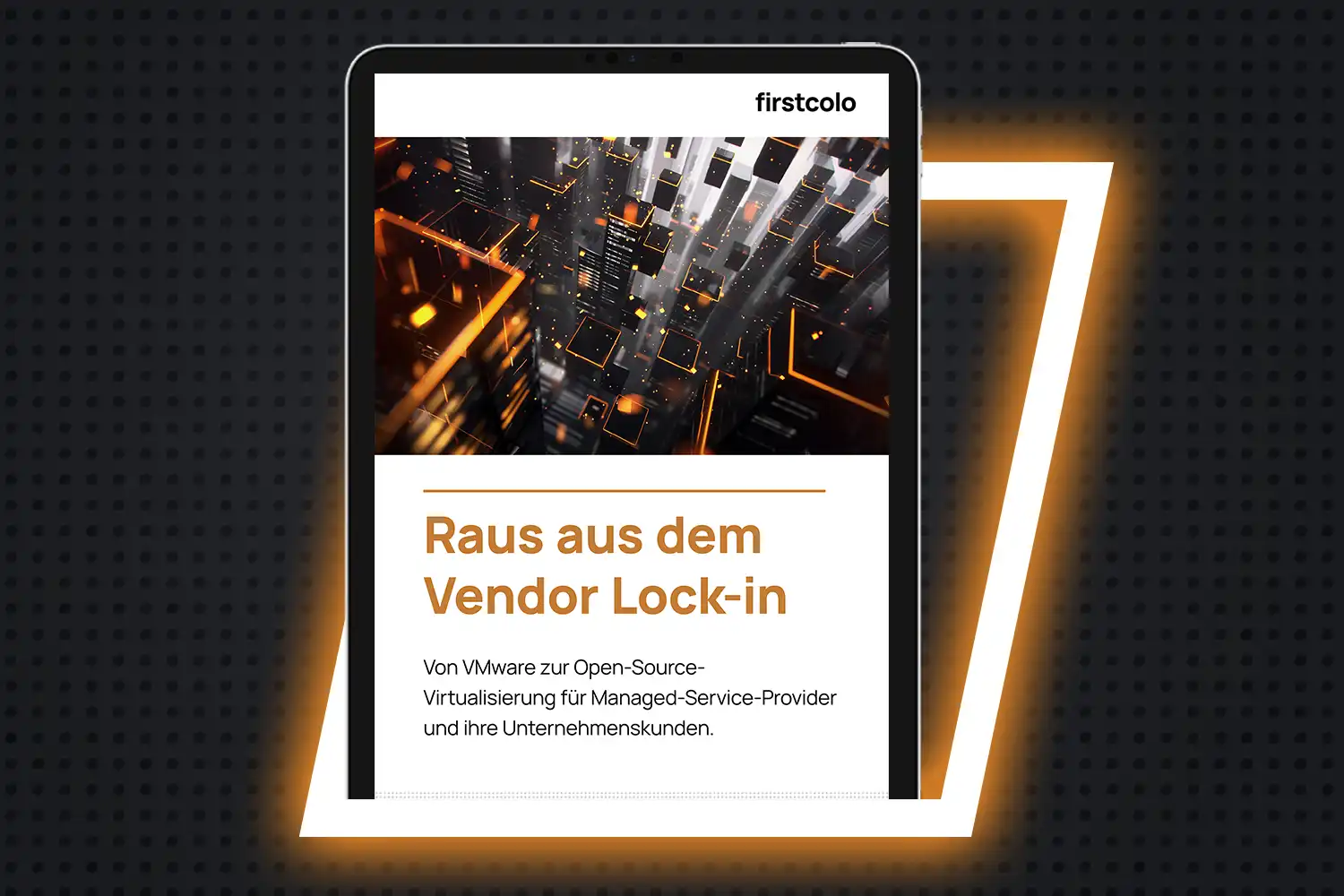
How can vendor dependencies be reduced and IT infrastructures made more flexible in the long term? The firstcolo whitepaper Escaping Vendor Lock-in shows which strategic advantages OpenStack offers and how companies can strengthen their cost control, planning security, and cloud sovereignty.