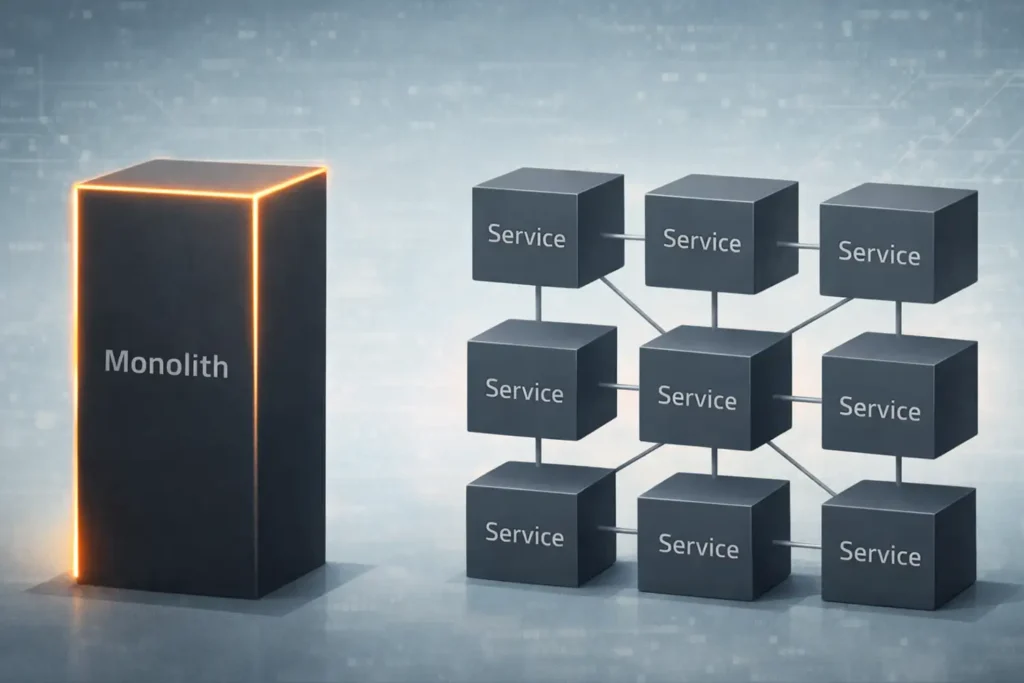
Monolithic System Architecture
A monolith, or monolithic architecture, refers to a traditional software solution where all components and functions are consolidated into a single system. All business functions share the same platform and are developed and operated as a single unit. This structure makes monolithic systems stable and easy to implement. A disadvantage, however, is that they are often difficult to scale, less flexible with changes, and slower to introduce new features.
MACH Architecture
MACH stands for Microservices, API-first, Cloud-native, and Headless. It is a modular, flexible architecture specifically designed for agility, scalability, and individual business requirements:
- Microservices: Individual, self-contained software components that can be developed, deployed, and combined independently of one another.
- API-first: Interfaces are the central focus, ensuring all functions are accessible via APIs and allowing systems to communicate with each other.
- Cloud-native: The architecture is designed specifically for the cloud, making it highly scalable and resilient.
- Headless: The frontend and backend are decoupled, allowing new channels and services to be connected flexibly.
Advantages: Faster time-to-market, flexible extensibility, better scalability, increased innovation capacity, cross-channel customer experience, and future-proofing. Compare “MACH Architecture: a new standard for digital excellence“.
Cloud-Native Architecture: Infrastructure or Platform as a Service
Cloud-native architectures (CNA) are specifically designed for use in the cloud. They form the foundation for modern internet products and services and are built to meet the high demands for scalability, elasticity, and resilience that today’s users expect.
Scalability/Elasticity
Cloud-native systems automatically adjust their resources to the current load, such as during increasing user numbers or high volumes of service requests per second. This means that users experience no performance degradation even during peak loads. When the scale is no longer needed—for example, when the number of requests drops—the amount of resources provided is also reduced, making cloud-native systems particularly cost-efficient.
Resilience
Interruptions are automatically detected and managed so that failures have no impact on users. Reliability is created through redundancies and IT security aspects such as DDoS protection, ensuring availability and stability are maintained.
The goal of CNA is to enable the scalable and reliable operation of modern cloud applications through loosely coupled, resilient, and highly observable systems with minimal effort. See Cloud Native Computing Foundation (Who we are).
Infrastructure as a Service (IaaS) vs. Platform as a Service (PaaS)
- IaaS provides virtual resources on which companies can deploy and manage their applications themselves.
- PaaS provides a ready-to-use platform on which developers can build, test, and deploy applications directly, without having to manage infrastructure.
Cloud-native architectures benefit particularly from PaaS offerings, as these enable rapid deployment, automatic scaling, and integrated resilience: this makes them ideal for SaaS providers and teams looking to accelerate time-to-market.
Principles of Cloud-Native Architectures (CNA)
Cloud-native is a concept where applications are developed and operated entirely in the cloud, allowing the full benefits of the cloud to be utilized.
The most important principles are:
- Containerization: Applications are packaged into standardized, portable containers and operated independently of the underlying infrastructure.
- Microservices: Functional components are implemented as independent services that can be developed, deployed, and scaled independently.
- DevOps: Characterized by the close integration of development and operations to reduce handovers, sources of error, and lead times.
- CI/CD (stands for Continuous Integration and Continuous Delivery/Deployment): Automated build, test, and deployment pipelines enable fast, repeatable releases.
Particularly dynamic environments such as e-commerce platforms or streaming services benefit greatly from cloud-native architectures. In these scenarios, peak loads occur frequently and unpredictably: in e-commerce, for example, through discount promotions, and in streaming services, through new series releases.
CNA-based concepts and solutions make it possible to handle such peaks by automatically scaling only the affected components, without needing to adjust the entire application or requiring manual intervention. This keeps performance and availability stable while ensuring resources are used efficiently. Cloud-native approaches thus offer added value by combining resilience with rapid responsiveness to changing requirements.
MACH Architecture vs. Monoliths: When which approach makes sense
The decision between a monolithic architecture and a MACH approach depends less on trends and more on the framework conditions and goals of a software product.
Three aspects are particularly relevant:
- Greenfield starts
For new software products or startups, MACH architecture offers obvious advantages. Microservices, API-first, and cloud-native principles allow for high flexibility, fast iterations, and targeted scaling of individual functions from the start. While monoliths can be implemented faster initially, they reach structural limits more quickly as functional scope and user numbers grow.
- Infrastructural framework
Those who operate applications in their own static infrastructure often benefit from the simplicity of monolithic systems. However, with the move to a cloud provider and modern platform services, these requirements change fundamentally. MACH architectures are designed to efficiently utilize cloud features such as automatic scaling, high availability, and distributed systems. While monoliths can be operated in such environments, they only partially exploit the potential of the cloud.
- Innovation and development capacity
With increasing pressure to innovate, architecture becomes the decisive factor. MACH architectures allow new functions to be developed independently, existing services to be expanded in a targeted manner, and technological changes to be adapted more quickly. In monolithic systems, changes are usually more tightly coupled, which can slow down development and extend release cycles.
Conclusion
Monoliths impress with their simplicity and stability, while MACH architectures show their strengths where dynamism, scalability, and speed of innovation are required.
Monolithic architectures are primarily suitable for manageable, functionally stable applications with clear requirements and low pressure for change. They are well-suited when simplicity, low complexity, and predictable loads are the priority.
MACH architectures, on the other hand, unfold their value particularly in dynamic software products, SaaS offerings, and platforms that are growing strongly, are frequently expanded, and must react to fluctuating loads. Companies that do not require high scaling or rapid innovation should weigh the added value of MACH against the high effort involved.
Also read, how the MACH architecture influences the choice of cloud provider.