IT Outsourcing: Why It's More Important Than Ever
Whether customer service, external and internal communication processes, management of production processes, or in the supply chain: All areas in companies are experiencing high demand for digital solutions to automate, monitor, and organize business processes. Consequently, this results in a wealth of data volumes to be processed, causing high costs and significant personnel and organizational effort.
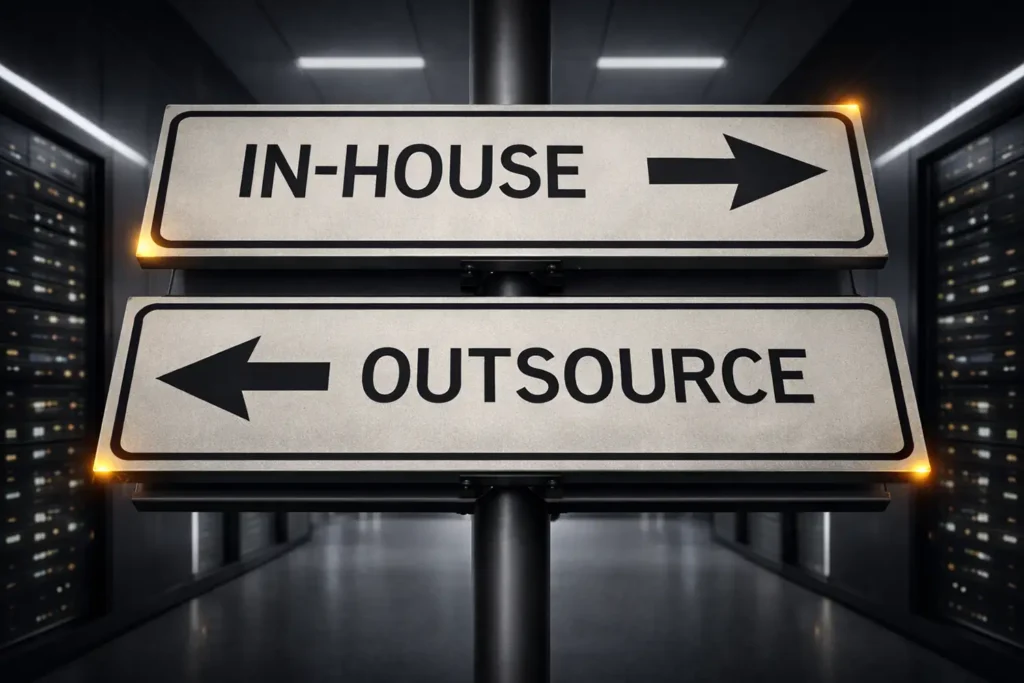
With the continuously growing digitalization of business processes (keyword: Digital Transformation) and the increasing requirements to manage data efficiently while maintaining the highest security standards, the question arises whether internal data management in a company’s own data center still makes sense at all.
As a solution approach, IT outsourcing to external data centers and private cloud environments presents itself. On one hand, they support companies in all matters of data storage and provisioning. On the other hand, they securely store sensitive corporate data at geographically separated server locations.
Why the Move to an External Data Center Is Worth It
Companies considering outsourcing their IT infrastructure often face the question: Is the move to an external data center really worth it? The answer is clear—especially when economic, technical, and strategic aspects are considered together.
A key advantage is financial relief. Operating an in-house data center involves high investment and operating costs—from purchasing and regularly renewing hardware to personnel and energy costs. By switching to a colocation provider such as firstcolo, companies instead pay only for the resources they actually need. Cost-intensive one-time investments (CapEx) are eliminated entirely. In addition, professional data center operators not only provide the server and network technology, but also handle maintenance, spare parts management, and ongoing optimizations—all at predictable monthly costs.
Furthermore, companies benefit from the high flexibility and scalability of external IT infrastructures. Capacities can be adjusted at any time—whether for growth, seasonal fluctuations, or strategic realignments. At the same time, colocation providers ensure optimal connectivity to leading internet service providers, high availability, and maximum energy efficiency. Modern data centers like those of firstcolo rely on sustainable technologies, high-performance networks, and the highest security standards.
Another decisive advantage: access to specialized expertise. Managed services and security solutions are delivered by experienced IT teams using state-of-the-art technology—without companies having to maintain their own specialist staff. This not only enables a high level of operational reliability, but also creates capacity to focus on the core business.
Key Benefits at a Glance
- Cost savings: No investments in proprietary hardware or data center infrastructure, billing based on actual usage
- Greater flexibility: Scalable IT capacities for dynamic business requirements
- Technology advantage: Access to modern IT architectures, managed services, and security solutions
- Predictability: Monthly calculable costs instead of high CapEx expenditures
- Expert knowledge included: Support by experienced IT specialists without internal personnel effort
Outlook: The Future of IT Outsourcing
A study by Lünendonk (“The Market for IT Services in Germany 2024”) provides interesting insights into the further development of IT outsourcing. Accordingly, 34% of surveyed CIOs and IT managers consider it realistic to no longer maintain their own capacities for operational IT operations by 2027.
This trend is evident in two ways: First, Software as a Service (SaaS) continues to gain importance—these applications no longer require in-house IT operations. Second, IT departments face significant demographic challenges. Over the coming years, an average of 17% of IT professionals will leave the workforce due to age. At the same time, experts assume that only around two thirds of the positions that become vacant can be refilled.
This development forces companies to rethink their IT strategies. The increasing demand for availability, performance, and security meets an increasingly strained personnel situation. Managed services, automation, and increased reliance on external IT service providers are therefore becoming central solution approaches to make operations efficient and future-proof.
For this very reason, at firstcolo we see IT outsourcing not just as a short-term efficiency measure, but as a strategic element of modern business management. Those who rely on specialized IT partners and high-performance data centers today create the foundation for stable, scalable, and resiliently positioned IT infrastructures—and ensure that technological innovations can be reliably implemented in the long term.