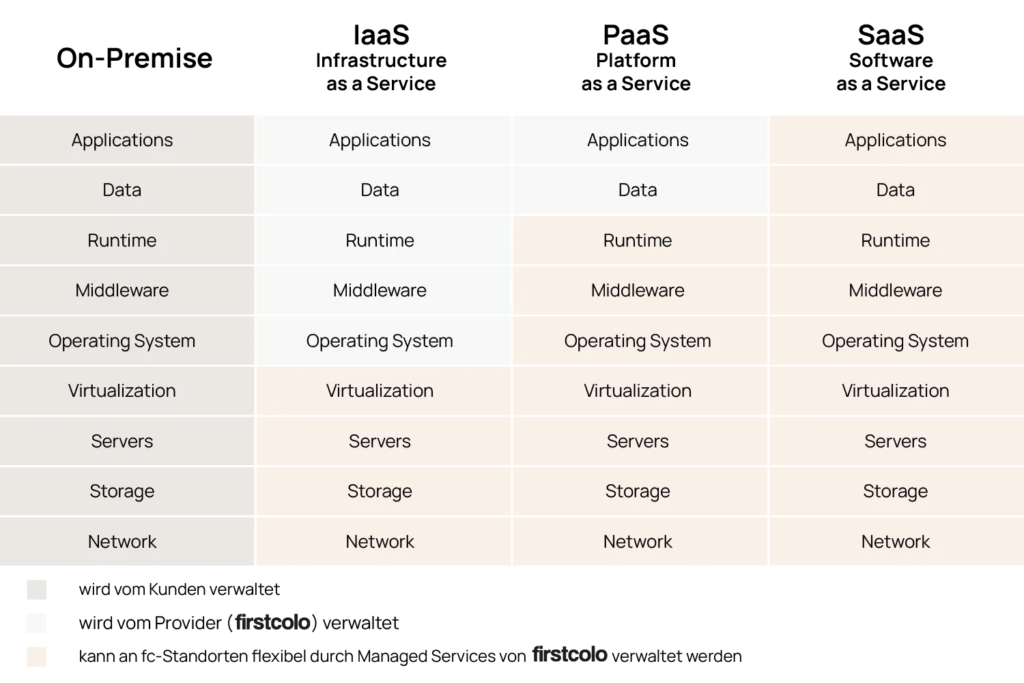
Cloud Computing Models at firstcolo
DBaaS thus describes a cloud-based database model where a provider handles the provisioning, management, and maintenance of the database. Companies use a fully managed database without having to install their own hardware or software. DBaaS solutions offer a wide selection of database types, such as relational, NoSQL, and in-memory databases.
Advantages of DBaaS
With Database-as-a-Service, companies can significantly simplify their database infrastructure. A key advantage is the relief of internal IT. The data center takes over the maintenance, security updates, and backup of the database, so you no longer have to perform these tasks manually. This not only saves time but also costs.
Scalability is another significant advantage. DBaaS allows databases to be scaled quickly and efficiently without the need to add physical servers or change configurations. If requirements grow, the provider simply increases resources – and vice versa.
Another crucial point is high availability. DBaaS services ensure that your database is available around the clock, supported by redundancy and failover mechanisms. This minimizes the risk of downtime.
Use Cases
Database-as-a-Service is particularly suitable for companies that develop applications and need to react quickly to changing market conditions. Developers can create, manage, and test databases with little effort. Automated backups and security updates keep the focus on actual development.
DBaaS is also ideal for data-intensive applications such as Business Intelligence (BI), analysis tools, or Big Data projects. It can be easily integrated into existing IT infrastructures and offers flexible storage solutions for large amounts of data.
Why DBaaS in a data center?
DBaaS in a data center offers additional security benefits and increased availability. Databases benefit from the robust security and backup mechanisms of a data center. Furthermore, the infrastructure of a professional data center ensures reliable performance, redundancy, and lower latencies.
The interplay of DBaaS and a high-quality colocation environment ensures that your database solutions are always available and optimally protected.