


Sustainability is part of our DNA

Sustainability is very important to us. We use 100% green electricity and state-of-the-art technologies to cool our servers.

Sustainability in focus

Our conscious decision to reduce emissions.
As data center developers, we at firstcolo make conscious decisions to minimize emissions from the very beginning.

We reduce embodied carbon and work with suppliers that offer comprehensive emissions reduction programs.

Through improved colocation services and technologies, we also make it easier for our customers to act sustainably.

We are proud of:

Our responsibility and partnership for sustainability

At firstcolo, one of our major goals is to keep the CO2 footprint of our data center operations as small as possible. To get closer to this goal, we have already implemented a number of key measures. Nevertheless, there is still potential for optimization.

We take responsibility for sustainable data centers.

In the energy-intensive data center business, sustainability is particularly important—we are aware of our responsibility. That is why, despite cost pressure, we continuously strive to make our operations more sustainable and thus reduce our ecological footprint.

We specialize in sustainable business models.

Since October 2022, we have had a new investor at our side in Cube Infrastructure Managers, which specializes in sustainable business models. Cube Infrastructure Managers supports companies in becoming leaders in sustainability by optimizing their environmental and social responsibilities.

Implementation of our ESG policy

Together, we are committed to mastering all tasks for a sustainable future. A key part of our activities is compliance with and implementation of our ESG policy. This policy underscores our commitment to Environmental, Social, and Governance (ESG).

We are proud to meet these standards and to continuously work on improving our processes and making them more sustainable.

Our commitment

Prima Klima certificate

1,000 trees planted: To mark the opening of our data center on Hanauer Landstraße, firstcolo is donating 1,000 trees for climate protection.
ESG policy

Our ESG policy reflects our commitment to the environment, society, and transparent corporate governance. Through concrete measures and clear goals, we actively advocate for a responsible future.
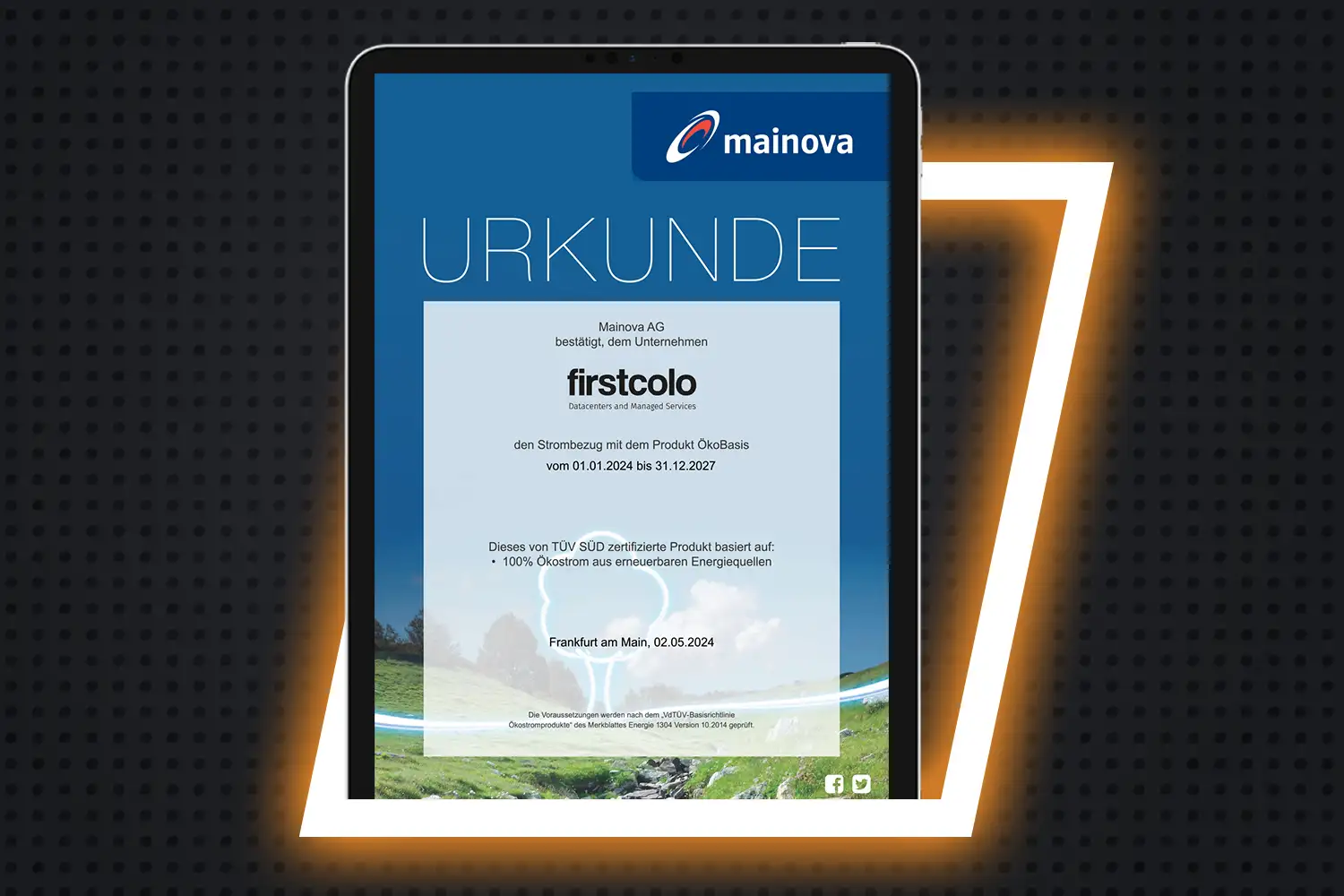
ÖkoBasis certificate

Thanks to the ÖkoBasis award from Mainova AG, operations at the firstcolo data centers are certified as being powered by 100% green electricity from renewable energy sources.

Sustainability: Frequently asked questions

Would you like to learn more about how sustainability is practiced and implemented at firstcolo?

Due to their increasing energy consumption driven by ongoing digitalization, data centers are a sustainability challenge. The IT capacities of German data centers have grown significantly in recent years. However, there are approaches for improvement. By using efficient server hardware and modern air-conditioning technologies, data centers can be operated more energy-efficiently.

Sustainable data centers are characterized by various criteria aimed at minimizing energy consumption and reducing environmental impact. A key indicator is the Power Usage Effectiveness (PUE) value, which measures the ratio of a data center’s total energy consumption to the energy actually used by the IT equipment. A low PUE indicates high energy efficiency. The use of renewable energy, such as green electricity from wind, solar, or hydropower, as well as the integration of on-site generation, plays an important role. Waste heat utilization and heat recovery systems help optimize overall energy use.

According to a recent Bitkom study, German data centers consumed around 15.4 billion kilowatt-hours (kWh) of electricity in 2021. This substantial energy demand reflects the impact of ongoing digitalization and the growing demand for IT services. The figures highlight the need to take sustainable measures to reduce energy consumption and improve energy efficiency in data centers.

A data center must be cooled to keep the temperature of IT equipment and infrastructure at an optimal level. Servers and other IT components generate considerable heat during operation. This heat must be dissipated to prevent overheating, which can impair performance or even lead to hardware failures. However, it is not only temperature regulation that is relevant in this context—optimal humidity for IT hardware is just as important. A properly cooled data center can operate more efficiently, as IT systems perform better and are less prone to errors at appropriate temperatures. This can also reduce energy consumption, because well-functioning hardware requires less energy for cooling.

The largest share of energy consumption in data center operations is mainly attributable to cooling and running the IT hardware. Cooling the IT equipment, which must be operated continuously to maintain optimal operating temperatures, accounts for around 30–40% of total energy consumption. Servers, storage systems, and network components that run constantly to process and transmit data consume around 40–50% of the energy. UPS systems (uninterruptible power supply), which ensure continuous power in the event of outages, contribute around 10–15% of total energy consumption. Lighting and other infrastructure such as air-conditioning and ventilation systems make up the remaining 5–10% of energy consumption.

A data center’s sustainability is assessed using various metrics and methods. Power Usage Effectiveness (PUE) measures the ratio of total energy consumption to the energy consumption of the IT equipment, while Carbon Usage Effectiveness (CUE) assesses the carbon footprint in relation to the IT equipment’s energy consumption. Water Usage Effectiveness (WUE) looks at water consumption relative to the IT equipment’s energy intake.

In addition, the use of renewable energy is measured, with a higher share contributing to a reduction in the CO2 footprint. Efficiency is also assessed by energy consumption per computing unit and by sustainability certifications such as LEED or ISO 14001. Life Cycle Assessment (LCA) provides a comprehensive evaluation of a data center’s environmental footprint over its entire life cycle. These metrics enable data centers to assess and improve their sustainability.

Do you have more questions? You can find answers in our glossary.

Contact

Feel free to send us a message

WordPress Cookie Notice by Real Cookie Banner