« Back to Glossary Index

What is IaaS (Infrastructure as a Service)?

IaaS is a cloud computing service: a service provider delivers virtualized IT infrastructure over the internet. The customer only rents the required components without purchasing them. They can then access this virtual infrastructure via broadband networks. They are only billed for the actual usage of the services.

Characteristics of IaaS

Infrastructure-as-a-Service (IaaS) offers flexible resources, as companies can quickly scale their infrastructure on demand, especially during peak loads. Furthermore, usage-based billing enables payment only for services actually used, eliminating high upfront investments. Since the cloud provider always delivers modern technology, users also benefit from secure and high-performance infrastructure. Additionally, virtualization optimizes resource utilization and reduces costs by enabling companies to share their resources efficiently.

Benefits of IaaS

  • Cost Savings:
    Companies avoid high capital expenditures and instead use flexible rental models.
  • Rapid Implementation:
    Infrastructure-as-a-Service enables quick deployment of new services. Users do not have to wait for new hardware installation.
  • Scalability:
    The model is particularly suitable for dynamically growing companies and start-ups. They can quickly adapt their resources to increasing requirements.

IaaS Cloud Types

Public IaaS Cloud:
This infrastructure shares resources among many users. Access is provided via the internet.

Private IaaS Cloud:
Companies operate their own isolated cloud. It offers high security standards and control.

Hybrid IaaS Cloud:
Combines public cloud and private cloud to unite scalability and security. Sensitive data remains protected.

Responsibilities

Provider Responsibility:
The provider manages hardware, power supply, cooling, and infrastructure security.

Customer Responsibility:
The customer is responsible for operating systems, applications, data, and security aspects.

In the Infrastructure-as-a-Service cloud service model, responsibilities are distributed between the cloud provider and customer as shown:
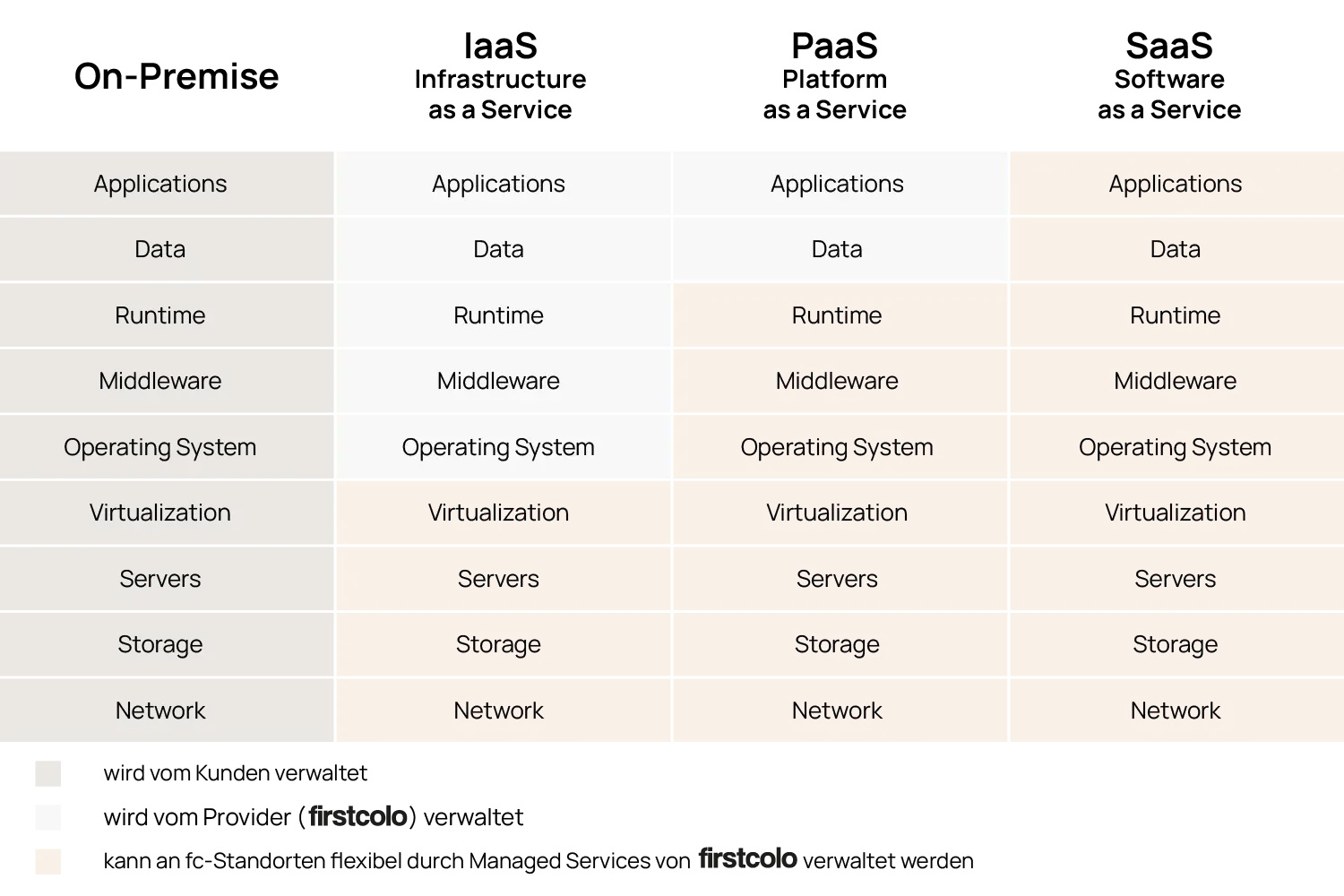
Cloud Service

Use Cases

Infrastructure-as-a-Service is suitable for applications with variable computing capacity requirements. Development projects or online shops, for example, benefit from flexible resources. Companies can respond quickly to changing requirements without having to install additional hardware. With stable usage, a dedicated infrastructure may be considered.

« Back to Glossary Index WordPress Cookie Notice by Real Cookie Banner