Functionality and Architecture
A NAS device typically consists of an enclosure with multiple hard drives or SSDs, a network connection, and its own hardware and software unit for data management. It often has its own operating system and is configured via a web-based interface. Data sharing is performed using standardized protocols such as SMB (Windows), NFS (Linux/Unix), or AFP (macOS), allowing different operating systems to access it seamlessly.
In everyday use, a NAS appears on the network as an additional drive. It is ideal for centralized storage of documents, photos, videos, or backups.
Advantages and Disadvantages of Network Attached Storage (NAS)
NAS systems offer numerous advantages:
Centralized Access: All users on the network access the same data repository. This simplifies collaboration and data management.
Data Security: Many NAS devices support RAID technologies that preserve data even if a hard drive fails.
Scalability: Storage capacity can be flexibly expanded depending on the model.
Ease of Use: Most systems can be set up and managed without in-depth IT knowledge.
Cost-Effective Alternative to the Cloud: Once purchased, there are minimal ongoing costs. This makes it ideal for organizations that do not want to store sensitive data externally.
Limitations
However, NAS systems also have limitations. Their performance depends on the network; with a weak connection, access can be slow. Additionally, NAS devices are designed for file-based access and are less suitable for database applications or high-performance workloads.
Distinction: SAN and DAS
DAS, NAS, and SAN Compared
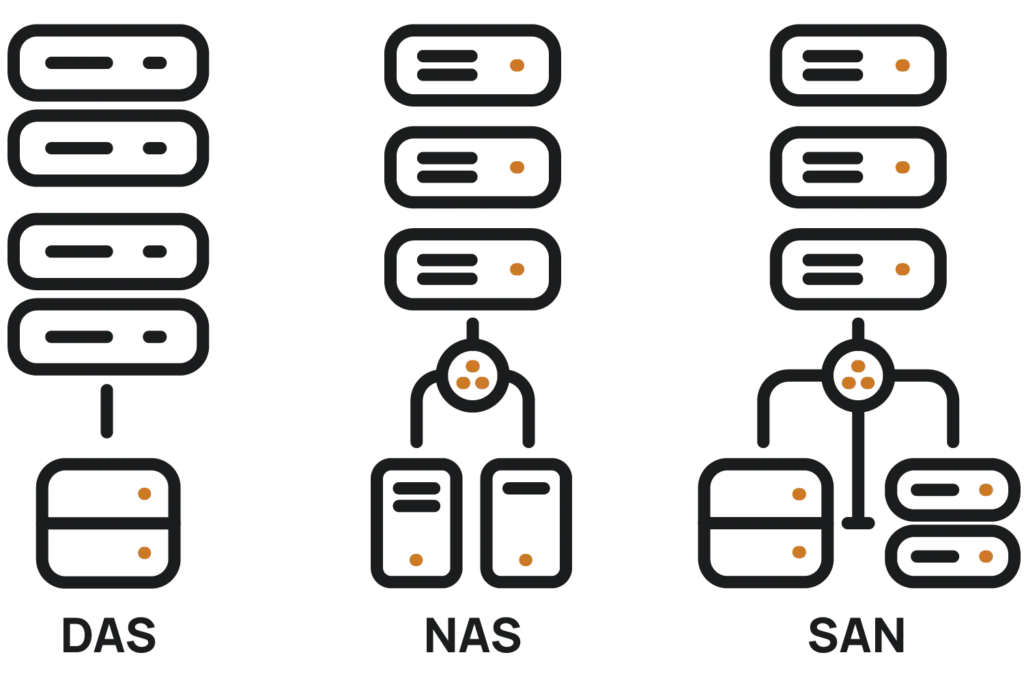
Compared to NAS, a SAN (Storage Area Network) operates at the block level and is designed for large, performance-intensive IT environments. It enables extremely fast access but is more complex and significantly more expensive.
DAS (Direct Attached Storage) refers to storage solutions directly connected to a single device, such as external hard drives. While simple and fast, they are not network-capable and therefore can only be used from one device.
Conclusion
