Efficient Orchestration for Container-Based Applications
Frankfurt, January 29, 2024. Kubernetes and containers have taken the IT world by storm. Together, these two technologies offer companies significant advantages. They enable improved productivity in development and cross-platform operations. Since containerized applications do not have their own operating system, they can also run without modification in any environment. They also require less computing power and storage than virtual machines, offering companies substantial savings potential.
However, containers become more complex as the application grows. Especially in production environments, the IT department often has to install, schedule, restart after failures, and connect a large number of containers to the outside world. “This only works with automated container orchestration. And this is where Kubernetes comes into play,” says Jerome Evans, founder and CEO of firstcolo GmbH.
Flexibility and Optimization
Kubernetes enables the management of container-based applications in a clustered environment, combined with the automation of container management. This means it automates the administration and control of containers. Distributed components and services can thus be combined across infrastructures. “Users can scale applications individually, make flexible adjustments, and optimize hardware utilization. Only in exceptional cases do companies not benefit from the system,” says Evans.
The technology was originally created by Google and later donated to the Cloud Native Computing Foundation (CNCF) for further development. Kubernetes as an application essentially offers the possibility to manage complex architectures, such as microservice architectures, very efficiently and securely in terms of performance and availability. “Especially in e-commerce or more complex SaaS architectures, it is worthwhile to orchestrate with a Kubernetes cluster,” explains the expert. Target groups here can be — depending on company size — IT decision-makers, DevOps engineers, or IT administrators. The solution thus supports users who are fundamentally involved with the deployments of the respective application.
Needs-Oriented Approach
“Many businesses are embracing the ongoing containerization of IT through Kubernetes, yet this is often accompanied by the desire for simple implementation,” says Evans. Approximately 56% of respondents in a representative survey by market research institute CCS prefer a complete container integration via third-party providers or an ensemble of providers and their own expertise due to the complexity of such an IT architecture [Source: Containers and Kubernetes Market Dynamics Report, Redhat].
Following this example and focusing on the end-user, cloud service providers offer solutions that significantly simplify the handling of open-source systems such as firstkube. Users no longer need extensive know-how to manage containers. “This is made possible by a user-friendly interface and competent advice from an expert,” adds the expert. With firstkube, users also access all necessary services such as monitoring, compute, networking, as well as object, image, and block storage centrally via a graphical user interface (GUI).
Significant Efficiency Increase
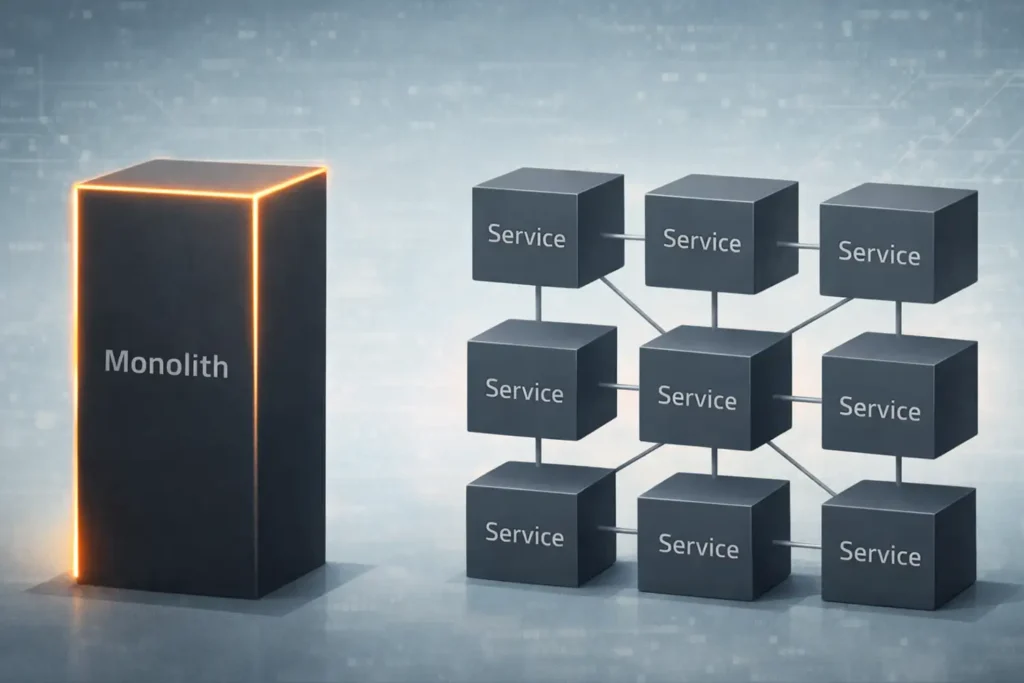
In practice, the application of Kubernetes clusters is particularly suitable for automating the lifecycle of an online shop, as it minimizes manual tasks for IT administrators. This strategy enables closer integration of the developer into the deployment process. However, increasing efficiency requires specific hard skills, as the alignment of a cluster must be strategic. “Before starting a project, the crucial question is whether the existing architecture is Kubernetes-ready. Ideally, the online shop should have a microservices architecture or gradually transition to one to optimize order, performance, and availability,” Evans explains.
Expert support is often indispensable here. Key advantages of a Kubernetes solution include rapid scaling, significant efficiency gains, and flexible availability adjustments. Teams can work autonomously on their assigned containers, which is particularly beneficial in a microservices architecture.
However, a modern architecture – preferably in the cloud – is always a prerequisite for successful Kubernetes implementation. While on-premise options theoretically exist, they require more adaptations and maintenance effort. “Overall, in the best case, appropriate advice and support from experts are needed to ensure smooth operation and effectively utilize the comprehensive benefits of Kubernetes,” concludes Evans.
Learn more about firstkube, the turnkey solution for easy Kubernetes use via a single graphical interface.