Virtualizing IT infrastructures is now standard practice in companies of all sizes. VMware has long been considered the undisputed leader in this field: powerful and stable, widely recognized, and offering extensive features. However, with Broadcom’s acquisition of VMware at the end of 2023, the market has changed.
Numerous companies are suddenly facing challenges: new licensing models, increased costs, and uncertainties about Broadcom’s future product strategy are causing many IT managers to question their infrastructure. Managed service providers, mid-sized companies, and organizations that previously relied on proven VMware technologies such as ESXi, vSphere, or vCenter are particularly affected.
While Broadcom still reported substantial profits in the first quarter of 2025 with its subscription model for VMware, a significant number of customers are likely considering switching providers due to dissatisfaction with the vendor’s business practices, weighing new options.
In these considerations, more and more IT decision-makers are turning to a transparent and economical open-source alternative: Proxmox VE. As an official Proxmox hosting partner, in this article, we show the advantages and disadvantages of Proxmox vs. VMware. We address why a switch to Proxmox can be beneficial for your company and show what you should consider during a migration.
Proxmox VE (Virtual Environment) is an open-source virtualization platform that combines Virtual Machines (VMs) with KVM and containers with LXC via its central web interface. Since its first release in 2008, Proxmox, which has an active community and provides regular releases, has developed into one of the most popular open-source solutions in server virtualization.
With Proxmox, companies receive a transparent and enterprise-ready virtualization platform that reliably supports both small IT environments and complex cluster structures. As with any open-source solution, users remain independent of the proprietary licensing models of a single vendor.
Features of Proxmox VE:
Thanks to its open architecture, Proxmox is not only popular among open-source advocates but is also increasingly used professionally by companies and service providers: including official Proxmox Hosting Partners like firstcolo.
Broadcom’s acquisition of VMware caused a stir in the IT world and a considerable amount of criticism. What was originally announced as an expansion of Broadcom’s portfolio quickly became a challenge for many VMware customers: the switch to a pure subscription model was particularly criticized. This was associated with sometimes drastic price increases, limited flexibility, and uncertainty regarding future product development.
Overview of the criticisms:
The consequence:
More and more IT decision-makers are questioning the continued use of VMware. This is also because alternatives like Proxmox VE are powerful, flexible, transparent, and significantly more cost-effective.
Anyone looking for an alternative to VMware wants to make as few compromises as possible: neither in terms of stability nor functionality. Therefore, a closer look at the differences between VMware and Proxmox VE is worthwhile. Both platforms offer extensive virtualization functions but differ significantly in licensing model, architecture, and flexibility.
Here is a direct comparison of the two systems:
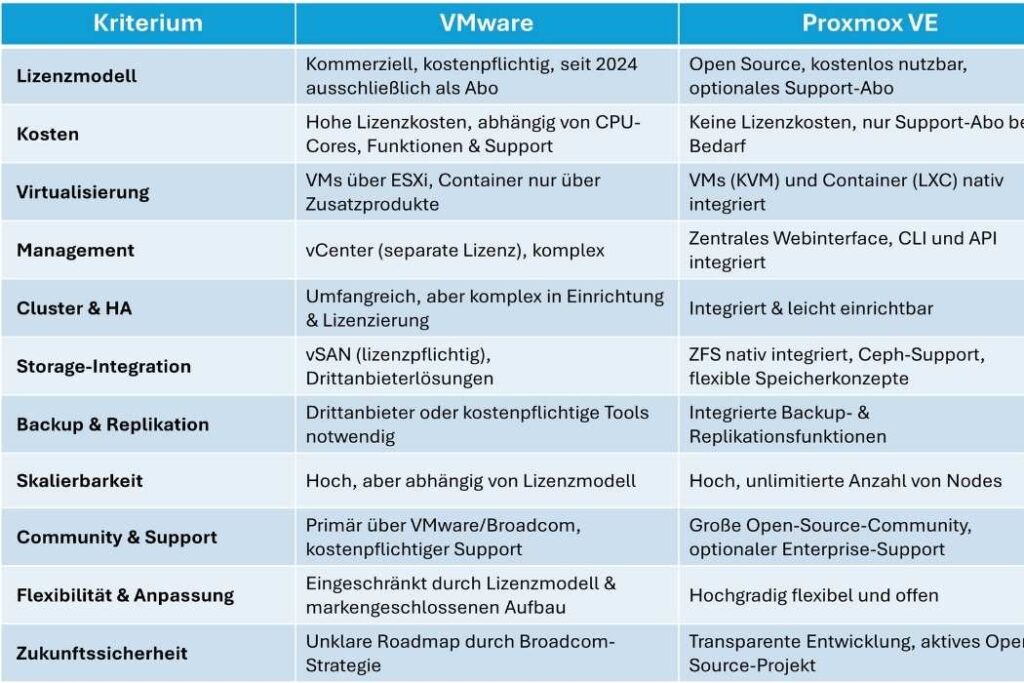
Proxmox scores particularly well in terms of cost, flexibility, and transparency. For companies, it represents a future-proof and controllable platform. It offers all the functions required for professional IT operations.
So, if you imagine the worst-case scenario: Even if Proxmox discontinues the product (Proxmox VE), you could continue to operate your own VMs with little effort on any current Linux platform.
Proxmox VE convinces not only as a cost-effective alternative but also through a variety of professional functions that make it particularly interesting for medium-sized companies, system integrators, and managed service providers. The platform is designed to meet the requirements of professional users without imposing the licensing hurdles of classic enterprise solutions.
The most important advantages of the Proxmox vs. VMware comparison at a glance:
Proxmox is open source and can be used free of charge with full functionality. There are no license fees per CPU, socket, or core. For productive environments, optional subscriptions with an enterprise repository and professional support are available. These can be booked flexibly and calculated transparently.
Proxmox’s modern web interface allows for convenient management of VMs, containers, storage, and clusters, even without in-depth Linux knowledge. In addition, a powerful CLI and a REST API are available for automation.
With KVM for classic virtual machines and LXC for lightweight containers, Proxmox offers both under a unified interface – without additional tools or complex integration.
Clustering multiple Proxmox nodes is quick and easy to set up. Features such as live migration, HA groups, and shared storage (e.g., Ceph, ZFS) are directly integrated, making them ideal for highly available setups.
Proxmox VE offers a full-fledged backup system including incremental backups, schedules, and optional encryption.
Proxmox’s open development process ensures full control and insight into the code. There is no dependence on a single manufacturer, and thus no risk of suddenly changed license conditions.
Proxmox VE convinces not only as a cost-effective alternative but also through a variety of professional functions that make it particularly interesting for medium-sized companies, system integrators, and managed service providers. The platform is designed to meet the requirements of professional users without imposing the licensing hurdles of classic enterprise solutions.
The most important advantages of the Proxmox vs. VMware comparison at a glance:
Proxmox is open source and can be used free of charge with full functionality. There are no license fees per CPU, socket, or core. For productive environments, optional subscriptions with an enterprise repository and professional support are available. These can be booked flexibly and calculated transparently.
Proxmox’s modern web interface allows for convenient management of VMs, containers, storage, and clusters, even without in-depth Linux knowledge. In addition, a powerful CLI and a REST API are available for automation.
With KVM for classic virtual machines and LXC for lightweight containers, Proxmox offers both under a unified interface – without additional tools or complex integration.
Clustering multiple Proxmox nodes is quick and easy to set up. Features such as live migration, HA groups, and shared storage (e.g., Ceph, ZFS) are directly integrated, making them ideal for highly available setups.
Proxmox VE offers a full-fledged backup system including incremental backups, schedules, and optional encryption.
Proxmox’s open development process ensures full control and insight into the code. There is no dependence on a single manufacturer, and thus no risk of suddenly changed license conditions.
The decision for a virtualization platform is only the first step. At least as important is the choice of a competent partner who supports you with implementation, operation, and maintenance. As an official Proxmox hosting partner, firstcolo offers tailor-made solutions that go far beyond pure hosting.
Our services at a glance:
Your advantages with firstcolo:
With firstcolo as your partner, you benefit from our many years of experience, our technical expertise, and our commitment to excellent customer service. We accompany you on the journey from VMware to Proxmox and ensure that your virtualization environment is optimally tailored to your needs.
Ready for the digital future?
Secure your capacities now
in the AI-Ready Greenfield Data Center!
Start Inquiry