Companies looking to make their storage strategy future-proof, cost-transparent, and scalable will find Storage on Demand a flexible alternative to classic in-house infrastructure, with the advantage of only paying for what they actually use.
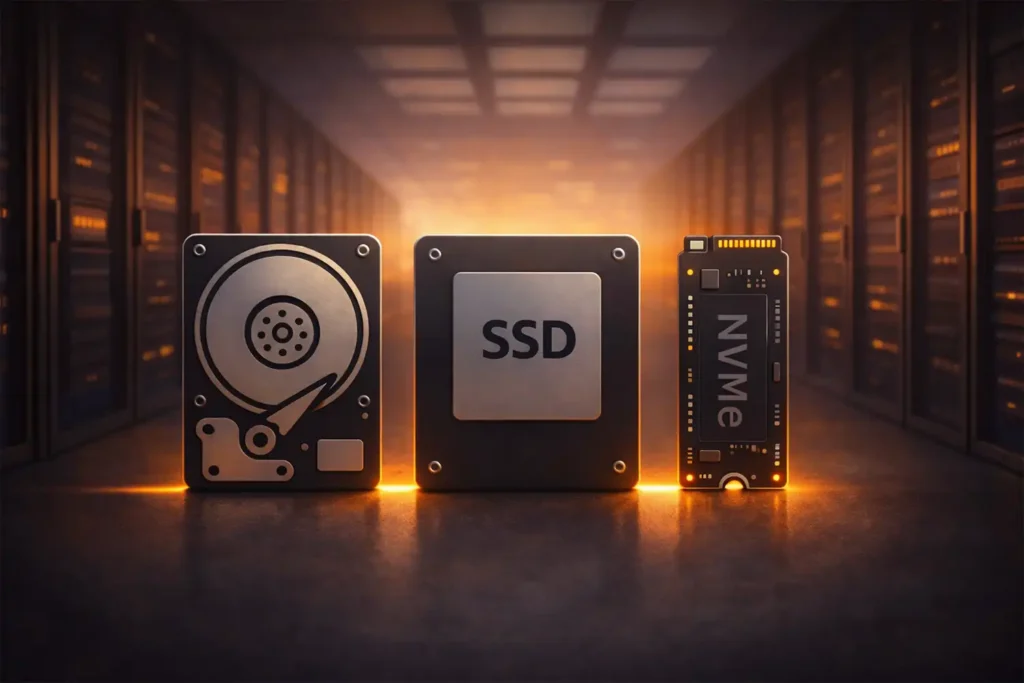
Not every type of storage is made for every task. Anyone who has ever tried to run a backup system on a USB stick or a highly available database on a simple NAS knows this. Today, companies face a wide selection of storage technologies that differ not only in capacity but also in their architecture and intended use. The storage requirements of a video archive with several petabytes of unstructured data look completely different from those of an SQL database for real-time analytics or a development team testing and discarding virtual machines.
Here are some examples to illustrate the differences:
Each of these systems has its own logic, requires special hardware or software, and incurs costs. For example, if you want high availability, you have to invest in redundant storage architectures. RAID arrays, mirrored hard drives, geo-redundant data centers: all of this is expensive to acquire (CAPEX) and incurs ongoing operating costs. Especially when growth cannot be precisely planned.
This is where Storage on Demand comes in. It is an operating model where storage is no longer rigidly purchased but used and billed flexibly according to actual demand. But what exactly does that mean, and when is which storage the right choice?
Storage on Demand means flexibly providing storage resources: when they are needed and to the necessary extent. In contrast to classic storage solutions, where companies buy infrastructure “in advance” (and often over-provision), Storage on Demand follows the principle: use instead of own. Technically, this is usually realized via virtualized storage platforms in data centers that can be dynamically scaled. Comparable to an electricity connection: you only pay for what you consume.
A concrete example: A company processes large amounts of data once a quarter for a market research campaign. Instead of maintaining expensive high-performance storage permanently for this purpose, it can temporarily rent it: for example, via an S3-compatible object storage solution or block storage for virtual machines. Once processing is complete, the storage is released again, without long-term commitment or unused capacities.
Storage on Demand can be local (e.g., via a data center with a direct connection to the corporate network) or cloud-based. The location is not important, but the principle: capacity, availability, and performance are based on actual demand.
The biggest advantage is obvious: cost control through flexibility. Companies no longer invest in storage they may never fully utilize. Instead, storage infrastructure is treated as an ongoing operating expense (OPEX), similar to electricity or water. This reduces capital commitment and makes IT more predictable and scalable.
Further advantages at a glance:
On-demand storage is therefore particularly useful when storage requirements change, are difficult to plan, or increase rapidly and unpredictably. It enables a response to dynamic requirements with low risk and high efficiency.
Not every storage type is suitable for every application scenario. Ignoring this risks unnecessary costs or even data loss. The choice of the right storage depends on several factors: type and structure of data, access speed, availability, scalability, and last but not least, legal or regulatory requirements such as data protection or retention obligations.
Here is an overview of the three main types of storage technologies and typical use cases:
File Storage stores data in a hierarchical structure of folders and files, as is known from conventional file systems. This makes it particularly suitable for environments where many users access the same documents:
Block Storage divides data into equally sized blocks that are stored and addressed independently. The logic of the data structure lies with the operating system or application, not with the storage itself.
Object Storage stores data as objects, including metadata and a unique ID. Unlike File or Block Storage, there is no classic directory structure here. Instead, scalability and access via APIs are paramount.
A software company hosting virtual machines needs high-performance Block Storage. An advertising agency with a large media archive relies on Object Storage. And an administration where employees access central documents daily benefits from File Storage.
There isn’t one right storage solution for everything. Hybrid concepts are often useful, such as File Storage for operational work and Object Storage for audit-proof long-term archiving. The key is to analyze the requirements and align the storage strategy accordingly.
Companies storing data must not only consider capacity and speed but also fail-safety. Because a storage location that cannot be accessed in an emergency is practically worthless. Especially in critical areas such as e-commerce, finance, or health IT, an outage can have dramatic consequences: from loss of revenue and reputational damage to legal repercussions.
In practice, high availability means: data must be accessible at all times. Even in the event of hardware failure, power outages, or network problems. To ensure this, extensive technical measures are necessary, including:
All of this involves considerable effort and high investment costs, both in acquisition (CAPEX) and ongoing operation (OPEX). An example: Anyone who wants to build a highly available storage cluster internally must invest not only in duplicate hardware but also in appropriate network infrastructure, cooling, security measures, and skilled personnel. For many companies, especially SMEs, this is not economically realistic.
Instead of investing in expensive high-availability architectures themselves, companies can use them as part of an “As-a-Service” model, on demand, scalable, and without long-term capital commitment. The underlying infrastructure is provided and maintained by the data center operator, who ensures security and availability.
A SaaS provider stores customer data in highly available Object Storage, mirrored across two locations. Instead of operating the technology themselves, they use a Storage on Demand platform with 99.99% guaranteed availability. If a component fails, a second storage location automatically takes over. For the SaaS provider, this means maximum fail-safety at predictable costs without their own investments in redundant systems.
Through the usage-based billing model (pay-as-you-go), the company only pays for the actually used storage volume. Scaling up or down is possible at any time. This makes the storage solution ideal for growing data volumes, seasonal use, or temporary projects.
Storage on Demand is a particularly sensible option when companies need to react flexibly to changing requirements, want to avoid high investments in their own storage infrastructure, or have specific requirements for fail-safety, scalability, and availability. The model is suitable for continuously growing data volumes as well as for temporary projects or highly fluctuating usage scenarios.
Storage on Demand is not a one-size-fits-all solution. It is crucial to choose the appropriate storage type for the respective purpose, whether Block, File, or Object Storage, and to integrate it meaningfully into one’s own IT architecture.
Companies looking to make their storage strategy future-proof, cost-transparent, and scalable will find Storage on Demand a flexible alternative to classic in-house infrastructure, with the advantage of only paying for what they actually use.
You want to be digitally future-proof and maintain your data sovereignty?
Secure capacity now
in the AI-Ready Data Center in Rosbach near Frankfurt.
Start inquiry