
From sovereign cloud architectures to innovative platform solutions: In this dossier, you will gain in-depth insights into current developments in cloud computing “Made in Germany”. Learn how companies use modern cloud technologies securely, scalably and in compliance with the GDPR – and stay informed about trends, best practices and solutions from the firstcolo ecosystem.

Over the years, cloud computing has become a cornerstone of modern IT infrastructures. Companies of all sizes, from small and medium-sized businesses to international corporations, are increasingly relying on flexible, scalable cloud solutions to drive their digital transformation efficiently and securely.
For IT decision-makers in particular, this raises a number of questions: Which cloud strategy makes sense for my company? How can data protection, GDPR compliance and cloud sovereignty be ensured? And how do European and German cloud providers differ from US hyperscalers? (You can also find out more about GDPR and the cloud here).
On this page, you will learn how your company can fully leverage the potential of the cloud: from the technological fundamentals and scaling, automation and AI integration through to meeting regulatory requirements. We provide a well-founded overview, highlight current trends and show what matters when choosing a future-proof cloud strategy.
With our cloud offerings such as firstcloud and firstkube, we provide you with a GDPR-compliant, high-performance alternative to international providers, operated in firstcolo’s German data centers.
Our platforms are based on open technologies and enable a flexible architecture: from classic virtualization environments to modern Kubernetes clusters. By integrating AI capabilities, business processes can be automated and optimized in a data-driven way. Digital sovereignty is at the heart of this: your data remains in Germany, protected by the highest security standards.
Many industries, from e-commerce and healthcare to manufacturing, already benefit from our tailored solutions. In our dossier, you will find practical use cases as well as specific recommendations for building your individual cloud strategy – aligned with your IT goals and regulatory requirements.
Cloud computing refers to the provision of IT resources such as computing power, storage or software via the internet: flexible, scalable and demand-driven. Instead of investing in their own physical servers and infrastructure, companies procure cloud services and thus receive perfectly sized capacity on demand, as required at any given time. The term “cloud” serves as a metaphor: the IT infrastructure moves into the background, while for users, simple access and dynamic availability are what matter most.
Technologically, cloud computing is based on the virtualization of resources. This makes it possible to logically separate physical systems from one another and distribute them efficiently, for example across multiple tenants or locations. Combined with automation, this creates an operating model in which IT resources are provisioned and billed as needed.
With the advent of fast internet connections and the spread of virtualization–technologies, cloud computing developed rapidly from the early 2000s onwards. Initially used primarily as an infrastructure model for start-ups, the cloud increasingly gained traction in enterprise environments as well, especially thanks to its flexibility and scalability. Today, cloud computing forms the technological foundation of many digital business models and is indispensable in modern IT strategies.

For businesses, cloud computing has long been more than just a technological trend. It is a building block on the path to digital transformation. Typical areas of use include, among others:
Cloud adoption is increasing across industries. Hybrid approaches that combine on-premises IT with cloud resources are particularly in demand. This is the case, for example, with private cloud solutions or dedicated infrastructures in the data center. Legal and regulatory requirements such as data protection, GDPR and digital sovereigntyare also becoming increasingly important. For businesses, it is becoming ever more important where, how and, in particular, by whom their data is processed.
Cloud services offer many advantages, such as high flexibility and scalability, enabling businesses to quickly adapt their IT resources to changing requirements. Capacity can be expanded quickly and easily. Different cloud models can also be used interchangeably: depending on requirements, businesses can choose public cloud, private cloud or hybrid cloud (i.e., public, private or hybrid cloud models).
For businesses, the cloud offers significant cost savings, as they do not have to operate expensive servers or infrastructure themselves. Instead, they pay only for the resources they actually use (pay-as-you-go or pay-per-use model). This enables more efficient and targeted use of the IT budget. In addition, businesses benefit from automatic load balancing and fault tolerance.
In addition, modern cloud providers offer numerous advantages: firstcolo, for example, operates firstcloud, a secure and GDPR-compliant cloud solution. This is particularly relevant for businesses that place the highest demands on data protection and want to remain independent of US providers and hyperscalers.
Not every cloud is the same, and not every model fits every business. Whether maximum control, maximum flexibility or cost efficiency: choosing the right cloud deployment model is a key factor in the success of an IT strategy. In this section, we introduce the four basic cloud models and show what matters when making a decision.
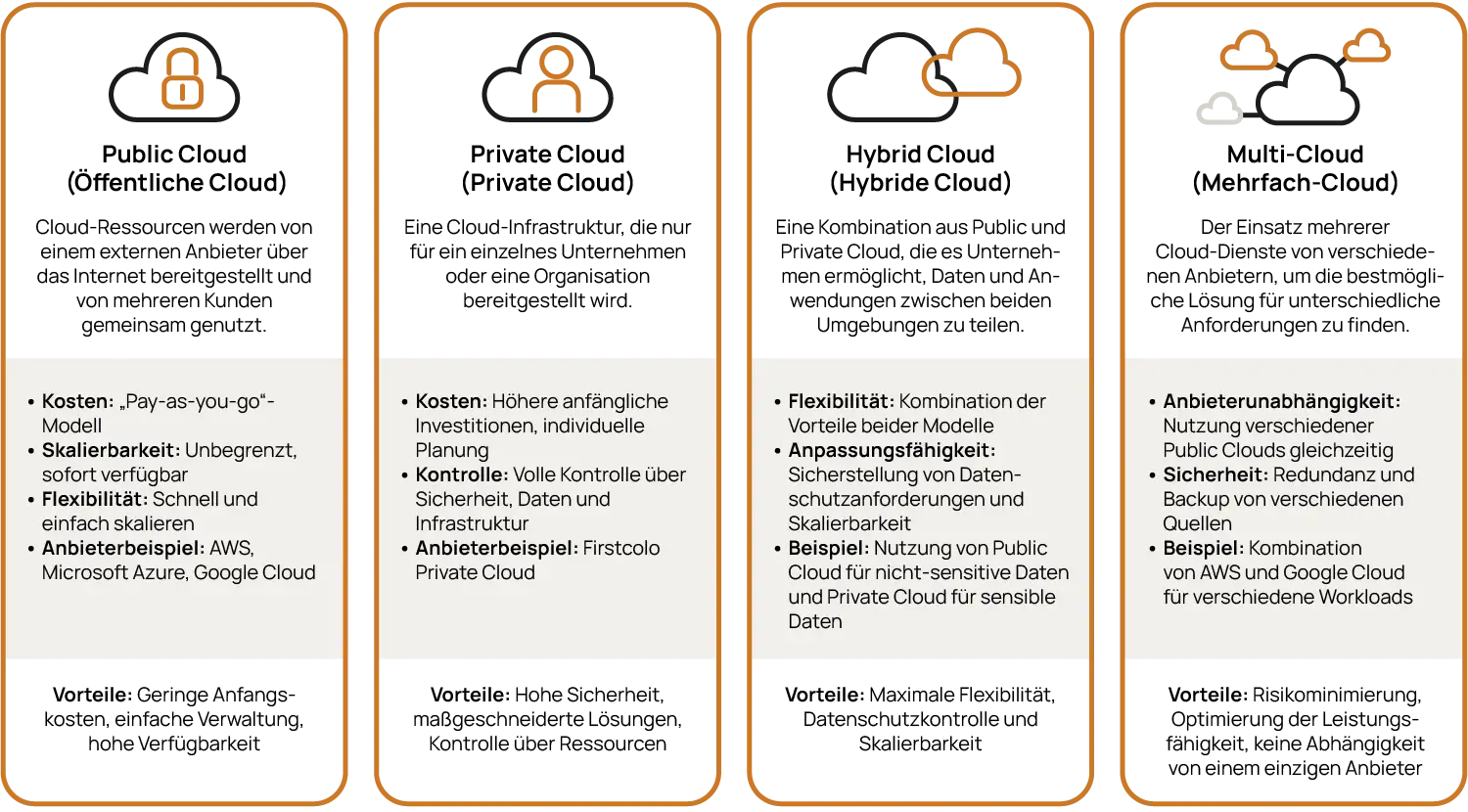
In the public cloud, IT resources such as computing power or storage space are provided publicly over the internet, usually by large international providers such as Amazon (AWS), Microsoft (Azure) or Google. The public cloud is flexible, easy to scale and follows the “pay as you go” principle: you only pay for what you actually use. This makes it particularly attractive for fast-growing or project-based applications.
However, businesses that rely on the cloud offerings of US hyperscalers face data protection challenges. Data processing may take place outside the EU, creating legal uncertainties (e.g., with regard to the GDPR or the CLOUD Act).
Suitable for:
Businesses with high requirements for security, compliance or customizability

The hybrid cloud combines the flexibility of the public cloud with the control of a private cloud. For example, businesses can store sensitive data in the private cloud while running compute-intensive applications in the public cloud. This makes it possible to achieve an optimal balance of efficiency, scalability and security.
A hybrid approach also enables a gradual move to the cloud. This can be useful when dealing with legacy systems or exceptionally complex IT landscapes.
Suitable for:
Businesses with heterogeneous requirements for security and scalability
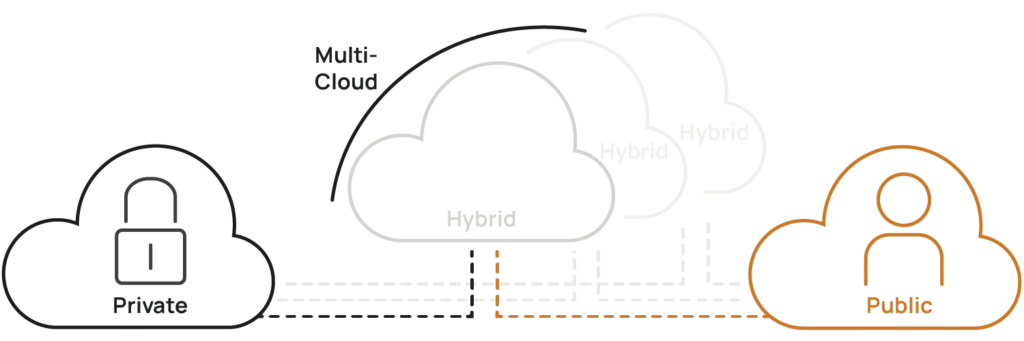
With the multi-cloud deployment model, businesses deliberately use multiple cloud providers in parallel, for example for different applications or locations. The goal is to avoid dependencies and combine the best services on the market. This provides maximum flexibility, but also increases management complexity.
Multi-cloud environments require a well-thought-out governance and security concept.
With firstkube, firstcolo offers a multi-cloud management service that enables k8s clusters (also template-based) to be deployed to different cloud environments and centrally managed.
Suitable for:
Businesses with heterogeneous requirements for security and scalability
Choosing the right model depends, among other things, on:
Tip: In many cases, a coordinated hybrid or multi-cloud approach provides the necessary flexibility without having to compromise on security and data sovereignty.
Public, private or hybrid cloud solutions as well as individual managed services: firstcolo supports businesses in implementing the right cloud model, with its own data centers in Frankfurt am Main, certification to ISO 27001, ISO 9001 and PCI DSS, and a focus on data sovereignty.
Cloud is not the same as cloud—especially when it comes to the technological foundation. As an operator of our own cloud infrastructure, we deliberately rely on open, high-performance technologies that offer our customers maximum flexibility, security and future viability. At the center are platforms such as OpenStack, Ceph and Kubernetes, which serve as a stable basis for highly available and individually configurable cloud environments.

Our cloud platform is based on an open-source stack that has proven itself many times over in practice. This is particularly important for businesses that value transparency, adaptability and digital sovereignty. OpenStack, as the orchestration layer for compute, storage and networking, gives us the ability to provide complex cloud infrastructures tailored to requirements. At the same time, we make our customers completely independent of individual software vendors or hyperscalers. The foundation is complemented by Ceph, a distributed object storage system that ensures fault tolerance, scalability and performance.
With this cloud architecture, we create the basis for tailored solutions that align with the requirements of mid-sized and large enterprises: whether for classic hosting, test and development environments, or highly available production systems.
Our cloud follows a modular architecture principle. This means that resources such as computing power, storage and network components can be scaled and combined independently of one another as needed. This flexible setup supports dynamic growth (“pay as you grow”) and enables a precisely tailored infrastructure for every phase of a project.
Separating logical and physical resources increases the platform’s resilience, while standardized interfaces ensure interoperability. This also makes it easy to implement hybrid cloud architectures, for example in combination with existing systems in your own data center or with us as your colocation partner.
A key building block of modern cloud usage is automation. Via standardized APIs, we make all functions of our platform available programmatically: from provisioning new virtual machines (instances) to configuring network components.
This enables our customers to benefit from infrastructure-as-code models and seamless integration into existing CI/CD and DevOps workflows. Automated management reduces sources of error, accelerates the provisioning of new environments and enables efficient resource utilization.
For businesses that rely on container technologies, we offer native Kubernetes integration. This powerful orchestration platform is ideal for microservices architectures, dynamic workloads and agile development processes.
Our Kubernetes clusters can be configured individually, either fully managed or with your own admin access. They can be combined with classic virtualization or bare-metal resources, depending on technical and regulatory requirements.
With new technologies, modular structures and standardized interfaces, we lay the foundation for cloud infrastructures that are viable in the long term. Businesses benefit from high investment security, as proprietary dependencies are avoided and new technologies can be integrated flexibly as needed.
Especially in times of increasing regulatory requirements and growing sensitivity to data protection, a technology-open cloud platform is a real advantage. It offers the freedom to design your own cloud architectures while providing the security of relying on a robust European infrastructure.
Growing volumes of data, global market dynamics and advancing digitalization make one thing clear: businesses that want to operate in a future-proof way cannot avoid cloud computing. The cloud is no longer just a place to store data—it now forms the backbone of a modern IT strategy.
Cloud technologies make it possible to scale digital processes flexibly, develop new business models and bring innovative products to market readiness in the shortest possible time. In times of disruptive developments (for example geopolitical circumstances, pandemics, etc.), the cloud creates the necessary infrastructure foundation for AI, data analytics or automation, enabling businesses to remain agile and responsive.
One of the greatest strengths of modern cloud platforms lies in their on-demand scalability: computing power, storage space and network resources can be adjusted flexibly as needed—without lead times or high investments in physical hardware. This enables businesses to respond quickly to new market requirements, absorb seasonal peak loads or efficiently support growth phases.
Mid-sized businesses in particular benefit from this flexibility. With an experienced partner like firstcolo at their side, they can rely on scalable infrastructure from a certified German data center—an essential building block for a future-proof IT strategy.
Cloud computing changes not only IT infrastructure, but also the way businesses think financially. Instead of high upfront investments (CAPEX), businesses rely on usage-based billing models (OPEX). The “pay as you go” principle enables precise cost control and creates financial agility: you pay only for the resources you actually use.
This reduces capital lock-in, simplifies budget planning and supports needs-based IT planning. In dynamic markets, this flexibility is highly advantageous.
Scalable cloud architectures are not only economically sensible, but also the key to greater innovation. Development and test environments can be provisioned in minutes, and new applications can be rolled out without lengthy procurement processes. This significantly shortens the time-to-market for digital products, strengthening competitiveness.
With an open, API-based infrastructure, modern cloud platforms such as firstcolo’s firstcloud provide optimal conditions for agile innovation processes.
Modern cloud infrastructures provide suitable resources for software architectures that can maintain redundancy, making it possible to achieve virtually any desired level of availability. Redundant systems and locations, as well as automatic data replication, ensure that business processes remain available even in a crisis. Recovery in the event of system failures, cyberattacks or natural events is fast and reliable.
This also supports business continuity—a key aspect of any future-oriented IT strategy. Especially in combination with professional managed services, this creates a robust, highly available IT foundation—regardless of whether it involves production applications, backup systems or hybrid scenarios.

Whether automated image processing, generative AI such as text or image models, predictive maintenance or intelligent customer analytics: artificial intelligence (AI) opens up new dimensions of efficiency and competitiveness for businesses. However, AI applications are data-intensive and resource-hungry—they require powerful, scalable and stable IT infrastructure. The cloud provides the ideal foundation for this.
Cloud computing enables AI projects to be implemented flexibly without businesses having to invest in expensive hardware or specialized on-premises infrastructures. Especially for machine learning processes, where huge volumes of data are processed and models such as LLMs (large language models) are trained, the cloud offers the necessary leeway: GPU power on demand, large storage capacities and maximum compute power—scalable and tailored to requirements.
With firstkube and firstcloud, firstcolo provides the right platforms to enable the secure, high-performance operation of cloud-native AI applications. Our data centers are AI-ready—they not only ensure stability and performance, but also provide GDPR compliance and safeguard your data sovereignty.
Learn more about the interplay between AI and the cloud and how businesses can benefit in concrete terms in the article “When AI meets the cloud”.
With platforms such as firstcloud (VM-based environments), firstkube (Kubernetes for containerized applications) and Proxmox (flexible virtualization based on open source), firstcolo offers tailored solutions for different AI use cases:
All platforms run in our certified, GDPR-compliant data centers in Germany: with maximum data sovereignty, low latency and direct personal support.
firstcolo offers more than just the technical foundation. We support our customers in implementing their AI plans: from selecting the right architecture and providing scalable resources to integrating into existing IT landscapes. Our commitment: to provide infrastructures that are not only high-performance, but also future-proof and trustworthy.

Data is now among the most valuable assets for many businesses. That is why confidentiality, control and legal certainty are more important than ever. Whether sensitive customer information, internal development data or critical business processes: cloud security is no longer just a technical decision. In view of geopolitical uncertainties, nothing less than a company’s ability to operate is at stake.
Especially for businesses in Europe, protecting personal data plays a central role. The GDPR requires the highest standards to be met. At the same time, it is becoming clear how crucial the question of the storage location is. Because anyone processing data in the cloud must also ensure that it does not flow uncontrollably to third countries or become subject to foreign access rights.
Political developments in recent months have reignited the debate about digital sovereignty. More and more businesses are realizing that dependence on US providers such as AWS, Azure or Google Cloud is not only a data protection issue, but a far greater risk. The rapid adaptation of tech corporations to political demands from the US government has shown: sovereignty cannot be outsourced.
In addition, the planned regulation of cloud providers in the US could make it easier for authorities to access stored data, posing a risk for European businesses. Against this backdrop, the goal of maintaining full control over one’s own infrastructure and data storage is gaining new relevance.
The market for European cloud and colocation services is growing rapidly. More and more businesses are choosing providers that operate their infrastructure exclusively within the EU, thus meeting requirements for data protection, security and corporate independence. Solutions that place European values such as transparency and control over one’s own data at the center are particularly in demand.
Given the current geopolitical situation, the move to a sovereign cloud has long been without alternative for many businesses. Those who invest in independent IT infrastructures today not only secure their data, but also their company’s long-term ability to act.
As an operator of its own data centers in Frankfurt am Main, firstcolo provides the foundation for a sovereign cloud infrastructure: a cloud made in Germany, operated under the strictest European data protection standards, in certified data centers and fully independent of non-European corporations.
With cloud solutions from Frankfurt (such as firstcloud and firstkube), businesses receive cloud services that are not only GDPR-compliant, but also meet the highest requirements for transparency, availability and economic independence. Thanks to the use of open-source technologies, vendor lock-in is also actively prevented.

Operating cloud infrastructures requires not only software, but also a reliable physical foundation. Yet German cloud providers are rare. As an operator of its own data centers in Frankfurt am Main, firstcolo provides the basis for a secure, high-performance and highly available cloud—directly from Germany. Our infrastructure is subject to German laws, data protection standards and quality requirements. In the Frankfurt region, firstcolo is currently building a new, state-of-the-art and energy-efficient data center: AI-ready, with high-density racks of up to 40 kW and a total capacity of up to 24 MW.
The big difference between us and many cloud operators is complete control as a German cloud provider: we operate our systems ourselves—without third parties, without detours, without hidden risks. ISO-certified processes, modern building technology, multi-level access controls and energy-efficient operations (PUE value of up to 1.25) make our data centers a reliable home for mission-critical applications.
Cloud hosting only becomes a trustworthy model when data protection is considered from the outset. As a German company with our own infrastructure, we guarantee that no data flows abroad. Our cloud offerings are GDPR-compliant, support industry-specific requirements (such as ISO 27001-2022, ISO 9001, PCI DSS) and allow our customers to retain full data sovereignty.
As an experienced cloud provider, we help implement technical and organizational measures that stand up to strict compliance requirements, such as in healthcare, banking or public administration.
High availability and protection against outages are indispensable in modern IT architectures. That is why our data centers rely on multi-layer security concepts: emergency power supply with UPS and diesel backup, redundant network and power routing, active monitoring, and comprehensive backup and recovery mechanisms. Unless otherwise requested, DDoS protection is part of our cloud infrastructure.
For businesses, this means: your data and systems are not only highly available, but also protected against physical and digital risks—around the clock, every day of the year.

firstcolo offers a reliable cloud and personal service. Instead of a call center with no accountability, you will receive personal advice from us, backed by technical expertise. We address your concerns individually. Our staff support projects from the initial architecture idea through migration and operations to scaling. We see ourselves not only as a supplier, but as your reliable partner and cloud provider in Germany.
Whether you want to implement a proof of concept, migrate new cloud workloads or build a hybrid environment: our experts are personally at your side—solution-oriented and on equal footing.

Cloud technologies are a widespread component of modern IT strategies in many industries. Depending on company size, security requirements and level of digitalization, very different goals take center stage: agility, scalability, data protection or compliance. The cloud offers the right model for this, from public to private and hybrid through to individually tailored solutions. Particularly important: an infrastructure that scales flexibly, understands industry-specific requirements and is consistently operated in Germany.
firstcolo provides businesses with cloud infrastructure that can be tailored precisely to real-world needs. Do you need scalable resources for day-to-day operations, high availability for critical applications, or full GDPR compliance? Our platforms are designed to map different requirements seamlessly. We combine technological performance with sound consulting and reliable data center operations—everything from a single source, directly in Germany.
The possible uses of cloud infrastructures are as diverse as the challenges of everyday digital operations. The most common scenarios include:
SaaS start-up, online retailer or regulated financial institution: the cloud adapts. What matters is choosing a partner who understands the challenges of your industry and your company’s individual requirements—and provides solutions that work.
SaaS and software providers need a stable, multi-tenant-capable infrastructure to deliver services reliably and with high availability. At the same time, they need room for growth and automated scaling.
The right cloud solution is not an off-the-shelf product, but a tailored operating model. Companies benefit most when technology, operations, and consulting are perfectly integrated. As a data center operator with its own infrastructure and personalized service, firstcolo offers a high-performance, secure, and customizable cloud that meets the demands of today and tomorrow.
Those who choose the cloud today benefit from true scalability, agile resource management and measurable cost control, for example through pay-per-use models that enable flexible billing based on consumption. Cloud solutions are also more attractive than ever from the perspective of the OPEX model versus high CAPEX investments in your own hardware.
But it is about more than efficiency and flexibility. Security, digital sovereignty and compliance are crucial when sensitive business data is processed. Businesses that consistently align their cloud infrastructure with European standards are already setting the course for a resilient, crisis-proof IT landscape.
Geopolitical developments in recent years have shown how quickly the framework conditions for international technology use can change. Those who rely on non-European providers sometimes take considerable risks, from government access to data to sudden contract or policy changes. A sovereign cloud strategy with a provider from Germany creates trust, legal certainty and entrepreneurial freedom to act.

As an operator of its own certified data centers in Frankfurt am Main, firstcolo provides cloud services with the highest standards for data protection, transparency and performance. Our solutions such as firstcloud and firstkube are fully GDPR-compliant, independent of non-European corporations, and consistently designed for security and availability. With personal consulting and individually tailored cloud concepts, we support businesses on their path to digital independence.
Your cloud strategy starts here.
Choose a cloud made in Germany that combines security, flexibility and sovereignty. Our experts will advise you personally and tailor everything to your requirements.