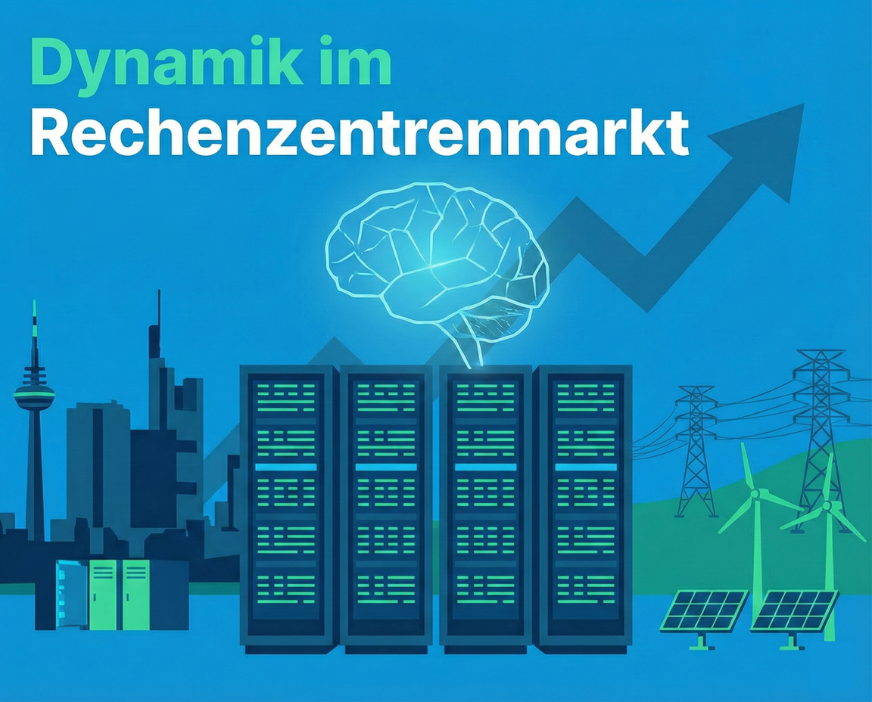


The demand for data center services is growing massively – in the German colocation market alone, a doubling of the installed IT capacity to around 3.3 gigawatts (GW) by the end of 2029 is forecast. As network bottlenecks and long lead times slow down expansion, data centers are transforming from pure consumers to active energy partners through waste heat utilization and flexible load management. This systemic approach is essential to secure Europe’s digital sovereignty despite tight energy markets.
A turning point: AI and the energy hunger of infrastructure
The digital transformation of the global economy is progressing at an unprecedented pace. At its center is
However, this
From silo thinking to systemic integration
A radical rethinking is necessary: away from the isolated consumer, towards the systemic actor. The challenge is immense, because grid connection requests can, according to a study by the International Energy Agency (IEA), currently involve waiting times of up to seven years. The solution lies in the role of the data center as an “energy orchestrator”.
Data centers must make their waste heat usable as a valuable resource for urban heat supply and synchronize load peaks with the availability of renewable energies. Technologies for island operation or the use of local power generation are becoming increasingly important in order to reduce dependence on overloaded public grids and at the same time act as a stabilizing factor in the energy system.
Social added value and location factors
Growth and sustainability must not be a contradiction. Although the energy demand per calculation at the chip level has been reduced by approximately 23 percent annually since 2013,
At the same time, the choice of location is becoming strategically decisive. While markets like Frankfurt are growing, locations like Berlin are also gaining in importance, which currently has an IT load of 152 MW and a projected growth rate of over 25 percent. Transparency towards the public, for example through the visible feed-in of heat into district heating networks, is essential to create acceptance.
Technology in practice: Design for the future
Future-proof data centers consistently rely on energy-efficient design and AI-optimized cooling. This is urgently necessary, as the industry’s average
In order to break through this efficiency limit, there is hardly any way around new technologies such as
Conclusion: Shaping the energy landscape of tomorrow
The industry is at a crossroads. Data centers today are far more than just data processors – they act as central partners in the energy transition. In view of globally declining vacancy rates averaging 6.6 percent, the pressure to act is high. Those who think systemically now and invest in efficient, grid-serving infrastructure not only secure the basis for future digital innovations, but also actively shape the energy landscape of tomorrow.